

On this page
Transparency and compositing
This is a historical engine study. The measurements and comparison files retain their recorded development revisions. For ordinary exports, follow the current export and review guide.
These engine changes are included in 4.0.0.dev2. They correct native PDF output and reduce repeated geometry work during export. The SVG output of the review recipe is unchanged.
Executable recipe · Full-size review · LaTeX caption

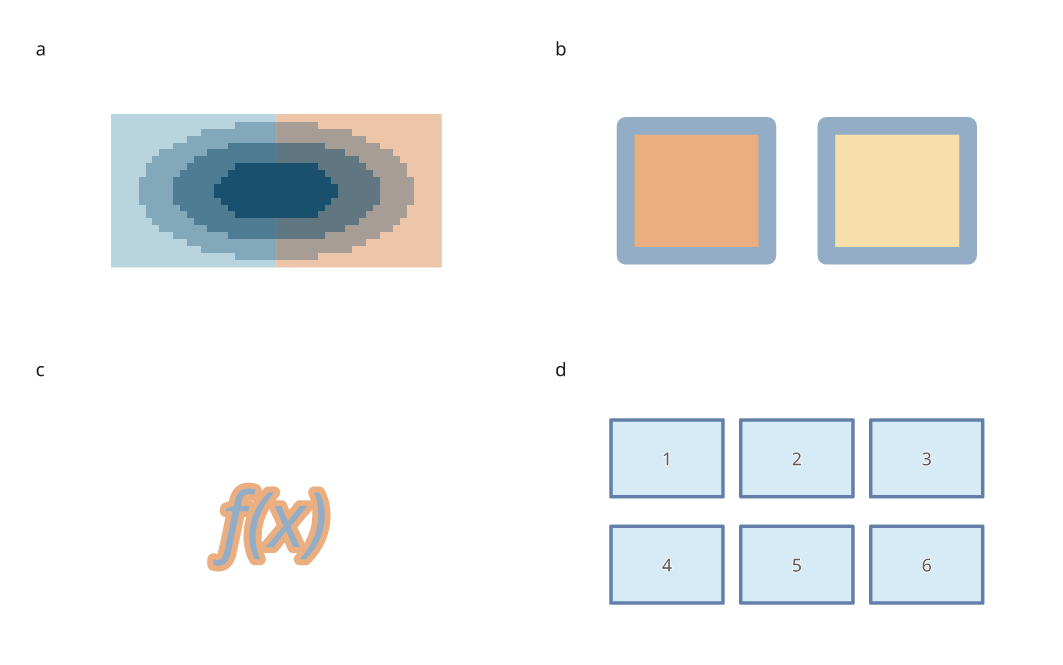
The artwork is original and contains no measured data. Panel a is an explicitly pixelated image; the other panels and all text remain vector in SVG and PDF. Descriptions belong in the separate caption.
What was wrong
PNG transparency. A PNG can record transparency in a palette or a color key rather than in an alpha channel. The PDF decoder previously checked only for an alpha channel, so transparent backgrounds became opaque and partial palette transparency disappeared. This affects both embedded bytes and file-backed images. Pillow describes these representations in its image concepts.
Opacity inside one primitive. A filled-and-stroked rectangle paints twice where its border overlaps its fill. Fading both operations separately darkens that overlap. Text halos and vector brushes can also perform overlapping paints. The PDF backend previously decided whether to create a transparency group by counting primitives, which missed these cases.
Repeated bounds. Every nested PDF transparency group walked its complete subtree to calculate a clipping rectangle. A label inside 32 such groups had its glyph bounds rebuilt 32 times, despite having the same placement and style.
Before and after
Both previews below use Poppler at 150 dpi with the same recipe, fonts and
physical dimensions. The previous version is the published v4.0.0.dev1.
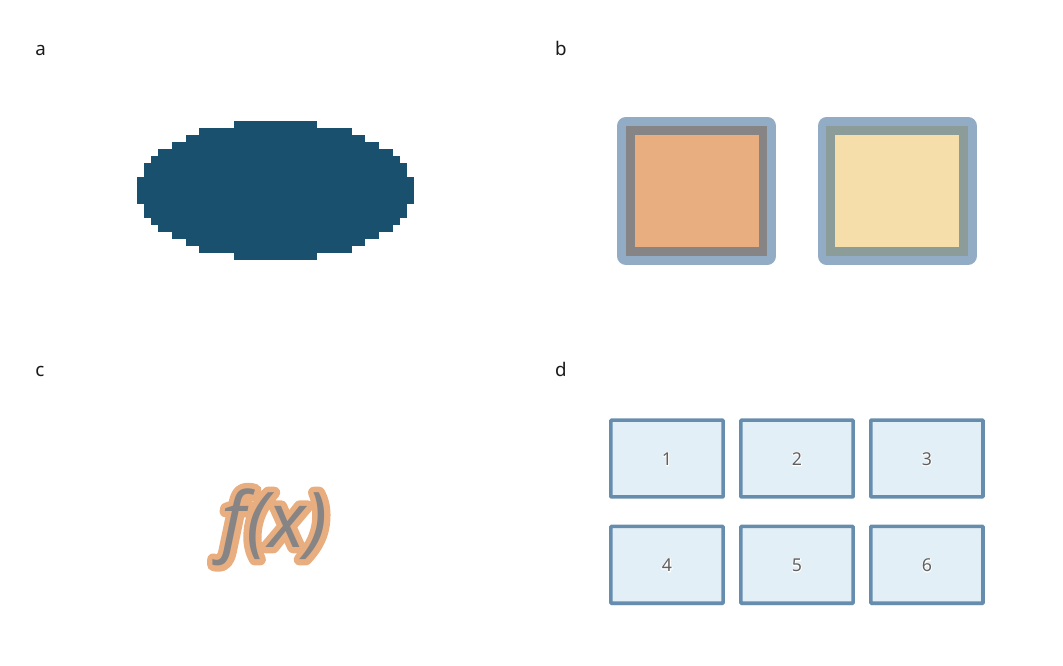
Previous PDF: palette transparency is lost in panel a; borders and halo overlaps are too dark in panels b and c.
Corrected PDF: the background artwork shows through the PNG, and each shape or text block fades after its internal paints are combined.
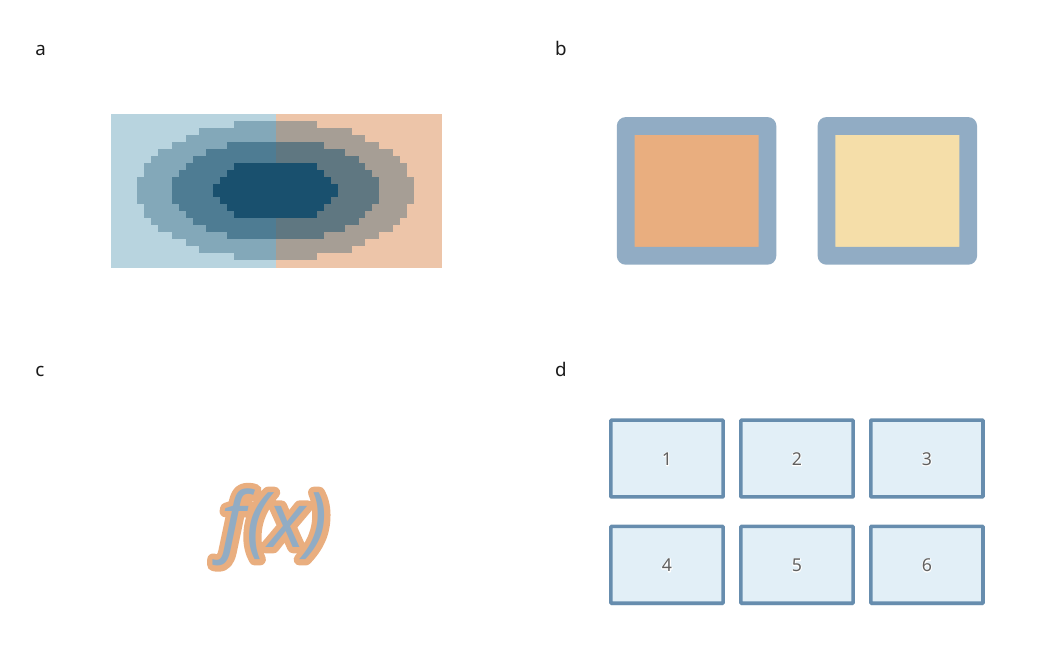
The PDF decoder now resolves PNG transparency before discarding the palette. Opaque images still omit the extra PDF alpha mask, and supported baseline JPEGs retain their compressed bytes. Ordinary single-paint vector marks continue to use a direct alpha state; marks with potentially overlapping paints get a transparency group.
Bounds and paint counts are cached within one page export. Cache entries distinguish inherited styles and world transforms, and are discarded after export. They do not alter the document's layout envelope or carry state into the next export. File edits therefore remain visible on subsequent exports.
Run the review
Use a checkout containing these changes; the published dev1 package predates them. Install the render extra and run:
python -m pip install -e '.[render]'
python examples/compositing_review.py --output out/compositing-review
The recipe writes SVG, PDF, PNG, captions and a report. It rejects warning/error diagnostics. Chrome/Chromium and Poppler are needed only for the independent preview comparison tools, not for native SVG/PDF export.
Performance evidence
The new groups32 workload contains 64 labeled vector blocks inside 32 nested
opacity groups. It tests repeated subtree analysis; it is deliberately deeper
than most ordinary figures. The existing grid64 workload checks an ordinary
64-plot document alongside it.
Median of three fresh Python 3.12.3 processes on the same Linux WSL2 workstation:
| Workload | Previous PDF export | Current PDF export | Previous / current peak process memory |
|---|---|---|---|
| 64 labeled blocks, 32 opacity groups | 1.1571 s | 0.0979 s | 55.9 / 55.6 MiB |
| 64 ordinary plots | 0.0619 s | 0.0600 s | 95.1 / 95.2 MiB |
This is about 11.8× faster for the nested-group PDF workload. It is not a general rendering speedup claim. The nested workload's SVG and PDF bytes match the previous engine exactly; its paints already had correct group boundaries. The defective single-primitive and PNG cases intentionally change PDF output. All 26 existing SVG/PDF visual baselines pass without replacement.
Previous measurements · Current measurements
The reports record each run, compilation/export phases, output size, dependency versions, source hash and peak process memory. Run the same comparison with:
python tools/benchmark_engine.py --case groups32 --case grid64 --repeat 3 \
  --output out/compositing-after.json
python tools/benchmark_engine.py --case groups32 --case grid64 --repeat 3 \
  --source /path/to/inklet-dev1 --output out/compositing-before.json
Regression checks include exact alpha bytes, independent SVG/Poppler interior pixel comparisons, embedded/outlined text, transformed bounds, inherited style changes and once-per-placement bounds evaluation. Rasterizer edge antialiasing and font hinting are compared separately from uniform interior paint colors.