

On this page
Diagram engine review
Inklet 3.1 improves measured modules, connector-label placement and obstacle routing. Text can wrap within a module's maximum width; labels reserve space against one another; redundant obstacles are removed even in larger diagrams.
Full-size figure · Executable recipe · LaTeX caption

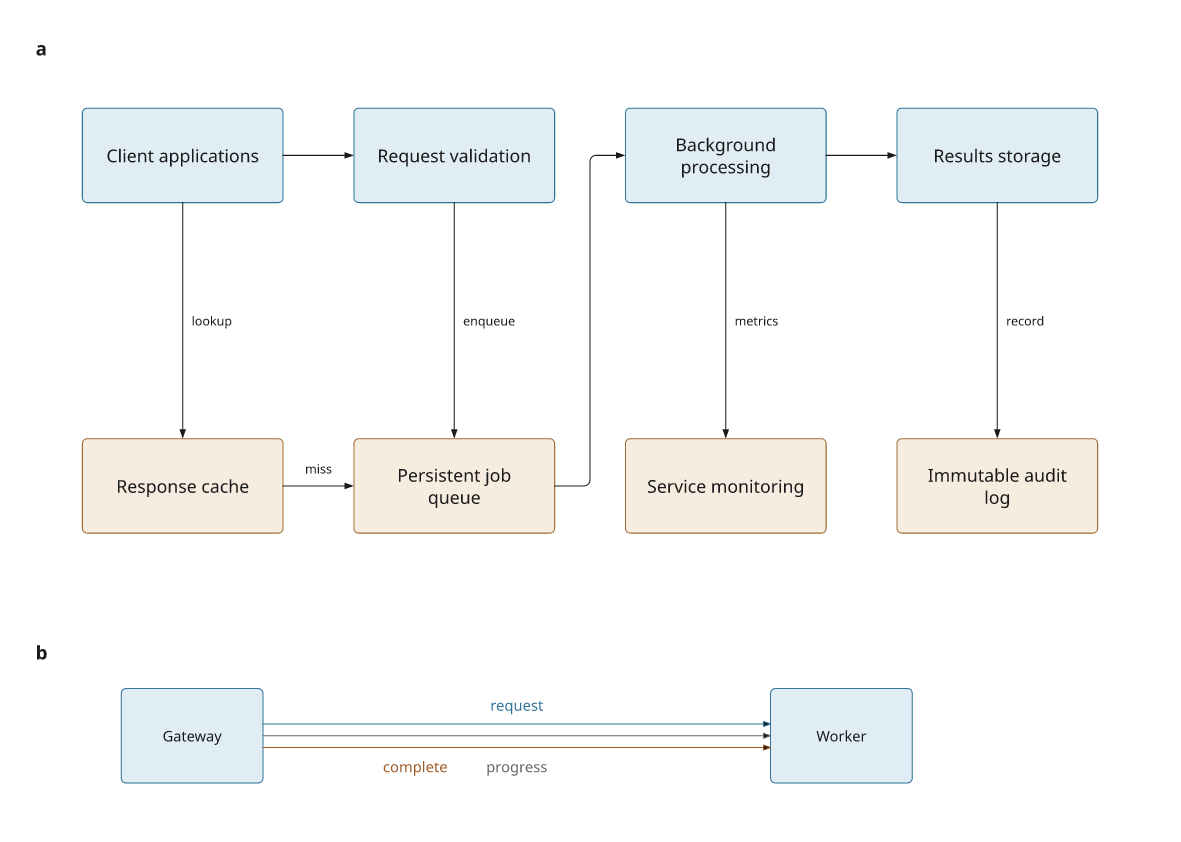
This original example depicts an illustrative service architecture. It uses measured ports and two explicit waypoints for the queue-to-worker connection. Panel b's labels are placed automatically. The figure has no embedded title or description; its explanation belongs in the separate manuscript caption. The recipe checks diagnostics and rejects errors and warnings.
Reproduce it
These changes are included in Inklet 3.1. Check out v3.1.0 to reproduce this recipe.
git clone --branch v3.1.0 https://github.com/Mapika/inklet.git
cd inklet
python -m pip install -e '.[render]'
python examples/diagram_review.py
SVG, PDF, PNG, text/LaTeX captions and a diagnostic report are written to
out/diagram-review/. No external assets or downloads are needed.
Modules with bounded width
import inklet as i

scene = i.composition(100, 65)
scene.add('validate', i.module(
    'Validate incoming requests and check permissions',
    min_width=34, max_width=34,
    text_style={'size': 3},
), x=5, y=5)
x, y = scene.point('validate', 's')
scene.add('queue', i.module('Persistent job queue', max_width=34),
          x=x, y=y+15, anchor='n')
scene.link('validate:s', 'queue:n', label='accepted')
doc = i.document(width=110)
doc.add('workflow', scene)
doc.save('workflow.svg', 'workflow.pdf')
max_width includes padding and label offsets. Text wraps at its available
width; the font size does not change. A smaller explicit text_style['width']
is respected. Port fractions refer to the resulting measured frame, so dependent
positions update when a label edit changes its height.
A single unbreakable word or a prebuilt Diagram wider than the limit raises
LayoutError. A wrapped label exceeding max_height also raises. Module label
offsets now enlarge the frame as needed to retain padding on every side.
Omitting max_width keeps natural-width sizing.
Connector labels before and after
Both specimens use the same recipe and raster renderer. The previous engine is
commit c60f6b0; the current engine includes label reservations and additional
clearance candidates.
Previous: the progress label's opaque background interrupts the request line.

Current: all three lines remain visible; labels avoid lines and one another.

Run python examples/diagram_review.py --labels-only to export this specimen.
The option works against the previous checkout too, by setting PYTHONPATH to
its src directory.
The placer first tries the existing midpoint, opposite-side and along-line positions. If those fail, it tries positions right beside bends, then moves the label out from the line in 0.25 mm steps to the nearest spot that is 0.25 mm clear of every node, label plate and arrowhead, and about the label offset from every other shaft. Further positions beside bends and two extra label-sized clearances come last. A final pass checks earlier labels against later shafts and updated label reservations. Unobstructed initial positions stay unchanged.
A label that cannot sit beside its line flags the link, and lint reports it as
LABEL_OFF_LINK (info). This is common on a link only a few millimetres long:
the label is wider than the gap between the two boxes, so it moves to just
above or below them, centred on the gap. In panel b above, progress has no
room beside the middle line and sits beside the complete label instead.
This is a bounded local placement method. It cannot guarantee a clear position in every diagram, and moved labels may require matching colours or more spacing to make their connection obvious. It does not optimize node positions and label positions jointly. Dense cyclic graphs still benefit from explicit waypoints.
Dense routing measurements
The benchmark constructs 36 nodes with six text blocks each and 54 edges, including long connections that require obstacle avoidance. It measures graph layout, routing and SVG export separately in fresh Python processes. A second specimen checks pruning of 450 nested rectangles.
The previous implementation skipped contained-obstacle removal above 200 boxes. That could retain every text box inside a node and exhaust the routing lattice. The spatial sweep checks only potentially containing intervals, then applies the same exact containment and duplicate-tie rules. It preserves input order and has no count-based cutoff. Worst-case overlap can still require quadratic work; the routing lattice retains its existing 60,000-node safety limit.
Measured on the same Linux/WSL2 workstation with Python 3.12.3; values are medians of three fresh processes per revision. Setup and imports are excluded. These timings describe this workload, not every diagram.
| Measurement | Previous engine | Current engine |
|---|---|---|
| Graph layout | 7.7 ms | 7.4 ms |
| Routing and page assembly | 102.4 ms | 75.5 ms |
| First SVG export | 4.6 ms | 4.5 ms |
| Failed avoidance routes | 1 | 0 |
| Rectangles retained in the pruning specimen | 450 | 225 |
Routing was 1.36× faster in this run and avoided the previous fallback. The pruning step itself now does work where the previous engine skipped it; its benefit is a smaller search lattice. Graph layout and SVG export are not changed by this pass; their short timings vary between processes.
Previous raw measurements · Current raw measurements
python tools/benchmark_diagrams.py --repeat 3 --output out/diagram-after.json
python tools/benchmark_diagrams.py --source /path/to/previous-checkout \
  --repeat 3 --output out/diagram-before.json
The SVG and PDF visual-regression corpus is unchanged by this update. The new regressions also check wrapping without font scaling, padding with signed label offsets, stable ports, deterministic label placement, clear channel labels and containment results against an exhaustive reference calculation.