

On this page
House styles for a figure set
A journal preset fixes what the journal asks for: page widths, type sizes, fonts. Projects that keep a house style usually decide more than that. They use one typeface for every figure, two or three line weights, one marker style, named colours for the things they keep showing (groups, doses, sample sizes), and one panel-letter style. They also have rules for text and keys, such as "no grey annotation text" or "label series directly". Written as constants in a style module outside inklet, these decisions get restated in every script, and nothing reports which figure broke which rule.
inklet.suite() states them once as a Suite. Figure scripts draw through the
suite, Suite.save writes and lints each figure, and Suite.build builds a
whole set, skipping figures whose inputs have not changed.
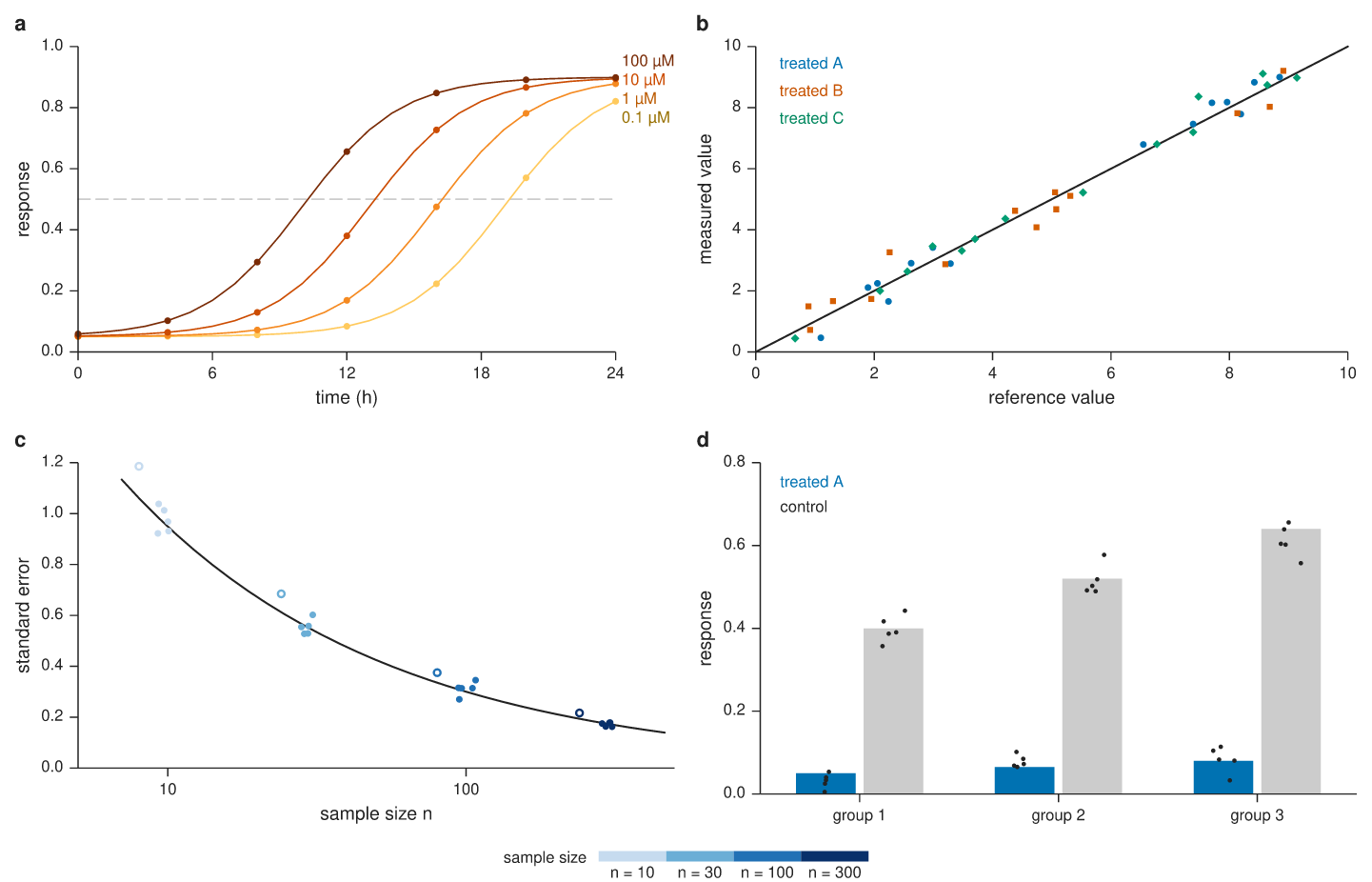
The complete script is examples/house_style.py. All its data are synthetic.
Define the suite
Each field has a default. The nested fields take a dict of the fields to change.
import inklet as i

house = i.suite(
    "lab",
    base="scientific.nature",                     # everything not stated here
    font="Helvetica, Arial, Nimbus Sans, Liberation Sans, sans-serif",
    ink="#222222",
    type=dict(tick=6, label=7, key=6, note=6, letter=8),        # pt
    lines=dict(data=0.6, fit=0.75, axis=0.5),                    # pt
    markers=dict(size=0.9, outline=False, ring=0.3),             # mm
    text=dict(bold="letters", muted=False, muted_colors=("#888888",), keys="outside"),
    palettes={"group": {"control": "#555555", "treated": "#0072b2"}},
    ramps={"size": {"n = 10": "#c6dbef", "n = 100": "#2171b5", "n = 1000": "#08306b"},
           "dose": "tol-ylorbr"},
    widths={"single": 89, "double": 183},
)
print(house.stroke("fit"), house.size("letter"), house.width("double"))
| Field | What it sets |
|---|---|
base |
A preset name or Preset for page geometry and journal limits. |
font |
The family list everything is measured in. The first installed family is embedded in PDF and SVG. TrueType and CFF OpenType (.otf) faces both embed as live text. |
allowed_fonts |
Families lint accepts (FONT_SUBSTITUTED). The default is the families named in font. |
type |
Sizes in pt for tick, label (axis titles), key, note (in-plot text and direct labels) and letter. |
lines |
Weights in pt for data, fit and axis, plus any extra={"guide": 0.4}. Lint allows only these weights in plot panels. |
markers |
Marker diameter in mm, whether filled markers have an outline, and the ring width of open markers. min_contrast deepens pale marker colours to that contrast on the paper. |
letters |
Panel-letter case and the gap to the panel. Panel letters are bold. |
text |
bold="letters" (bold only for panel letters), muted=False (no grey text), muted_colors, label_contrast (WCAG ratio for direct labels), halo and keys="outside" (no keys inside plot panels). |
palettes |
Categorical colours by name: {key: colour} or a sequence. |
ramps |
Sequential colours by name: an inklet ramp name, a list of stops interpolated in OKLab, or ordinal {key: colour} stops. |
widths |
Page widths in mm by name. |
export |
Formats, PNG dpi, text mode, write="changed" and ids="document". See below. |
lint |
Extra lint() keywords, such as min_font_pt or max_height_mm. |
house.customize(lines={"data": 0.5}) returns a copy with that field merged.
A dict merges into the nested style fields (type, lines, markers,
letters, text, export); palettes, ramps, widths and lint are
replaced whole. A suite is immutable: its mappings are read-only copies.
house.fonts() reports the file each style resolves to on this machine and
whether a PDF can embed it.
Draw through it
A with house: block makes the suite's theme the active theme, so text,
panels and keys are measured in its font and sizes. The helpers return the
keywords or nodes for the house style:
points = [(t / 10, 0.3 + 0.06 * t) for t in range(11)]
with house:
    p = house.panel(60, 40, x=(0, 1), y=(0, 1))
    house.axes(p, x="time (h)", y="response")             # tick/label sizes, axis weight
    p.line(points, **house.line("treated"))                # palette colour, data weight
    p.line([(0, 0.25), (1, 0.95)], **house.line("#222222", "fit"))
    p.scatter(points[::2], **house.mark("treated"))        # filled, no outline
    p.scatter([(0.5, 0.2)], **house.mark("control", hollow=True))   # ring in its own colour
    house.end_labels(p, {"treated": points[-1], "fit": (1, 0.95)},
                     colors={"fit": "#222222"})
house.end_labels writes each label just right of the point it names, in its
series colour. The colour is deepened along its own lightness until it reaches
text.label_contrast on the paper (house.text_color), and a grey series is
labelled in ink. Labels that would overlap are moved apart by the smallest
total distance that keeps them in order (layout.label_search.stack). For
curves drawn with name=, Panel.label_lines does the same from the curves.
house.color("treated") reads a palette, house.ramp("dose")(0.7) samples a
ramp, and house.stops("size") returns ordinal stops.
house.marker("circle", "treated") is a single marker for a hand-built key.
house.label("text", role="key") is a text node at a role's size, never bold.
Lay out a page
house.mosaic is inklet.panel_mosaic with the suite's letters and a named
width. Letters in a row share one baseline, and the panels below them start at
the same height whether the letter is a or b. Its gap and margin default
to 3 and 2 mm; any panel_mosaic keyword overrides them.
header_bounds="ink" keeps the placement of inklet 4.9 and earlier, where
each letter was measured by its own ink.
def panel(w, h):
    p = house.panel(w, h, x=(0, 1), y=(0, 1))
    house.axes(p, x="x", y="y")
    p.line(points, **house.line("treated"))
    return p

with house:
    page = house.mosaic(["a b", "c c"], {"a": panel, "b": panel, "c": panel}, height=90)
house.document() starts the suite preset's live Document for figures laid
out on a column grid; its panel letters follow the base preset's letter style. house.figure() is a plain page at a named width on the
suite theme.
Save and check
result = house.save(page, "dose_response", out="figures")
print(result.summary())
save writes figures/dose_response.svg, .pdf and .png and returns a
SaveResult with the paths, whether anything was written, the height and the
lint diagnostics. The export defaults are:
text="embed": PDF text is live TrueType (CIDFontType2, "Type 42") and SVG text carries a subset of each face. No font-file path is written into the SVG, even whenfontnames a file.write="changed": when every file's bytes would be unchanged, nothing is written and the timestamps are kept. When any file changes, the whole set is rewritten with one modification time.ids="document": SVG element ids are numbered per file, so a figure's bytes do not depend on what was built before it in the same process. These ids are not the node ids the layout editor and viewer map elements back to; setexport={"ids": "nodes"}for SVGs those tools will open.
Lint runs with the base preset's limits, the suite's fonts and its house
rules (Suite.lint_rules()). The house rules add five warning codes:
| Code | Reported when |
|---|---|
STROKE_TIER |
An author's stroke inside a plot panel is not one of the lines weights. Axis, key and colour-bar strokes are not counted. |
MARKER_OUTLINE |
A filled marker has an outline in another colour (markers.outline=False). |
MUTED_TEXT |
Text is grey (low OKLab chroma, lighter than slate ink) or in text.muted_colors (text.muted=False). |
BOLD_TEXT |
Bold text is not a panel letter (text.bold="letters"). |
KEY_IN_PANEL |
A legend, size key or colour bar is part of a plot panel, over the data or beside it, rather than one shared key outside the panels (text.keys="outside"). |
The same rules can be used without a suite:
inklet.lint(node, house=inklet.diagnostics.HouseRules(bold="letters")).
house.check(figure) lints without saving. A finding you keep on purpose can
be acknowledged with expect={"KEY_IN_PANEL"}, as for any other lint code.
Build a figure set
def figure_one():
    with house:
        return house.mosaic(["a b"], {"a": panel, "b": panel}, height=45)

report = house.build({"dose_response": figure_one}, out="figures")
print(report.ok)
build takes {name: callable} or {name: "module:function"} (the default
function is make_figure). For each figure it computes a fingerprint from
the suite, the figure's function (its qualified name, any functools.partial
arguments and its source file), depends= (files every figure reads, such as
a style module), inputs={name: [data files]} and the inklet version. A
declared file that is missing fails that figure. A
figure whose fingerprint matches the last build in out/.inklet-build.json
and whose files exist is reported as unchanged and not built. Data files
that are not listed in inputs are not seen, so pass force=True after
changing one.
isolate=True (the default) restores sys.path after each figure and forgets
the project modules it imported. Modules from the standard library,
site-packages and inklet stay cached. Two figure modules that import different helper modules of the same
name, from different directories, then each get their own. A figure that
raises is reported as failed with its traceback, and the remaining figures
are still built. The printed table lists each figure's status, height, lint
counts and the house rules it breaks.
Limits
- The house rules check what lint can see in the built tree. A colour baked into a raster image, or text drawn as outlines by the author, is not checked.
STROKE_TIERchecks strokes inside plot panels only. Strokes in schematics built withplace()are not checked, because their weights are usually set for the drawing.Suite.builddecides whether a figure changed from the files it is told about. It does not trace data reads, other modules the figure imports, font files or installed libraries; passforce=Trueafter changing those.- A
with house:block sets the process-wide theme, so suites are not for use from several threads at once.