

On this page
Save and restore layout choices
Experimental: the API may change.
The dev7–dev11 previews introduced uniform artwork scale, named text and callout decisions, and supported appearance fields; those milestones explain the saved schema history below. Save placement and dimension edits separately from a composition recipe, then restore those choices when its data, labels or content change. The saved JSON records only differences from a reference recipe. Unedited source decisions remain in control.
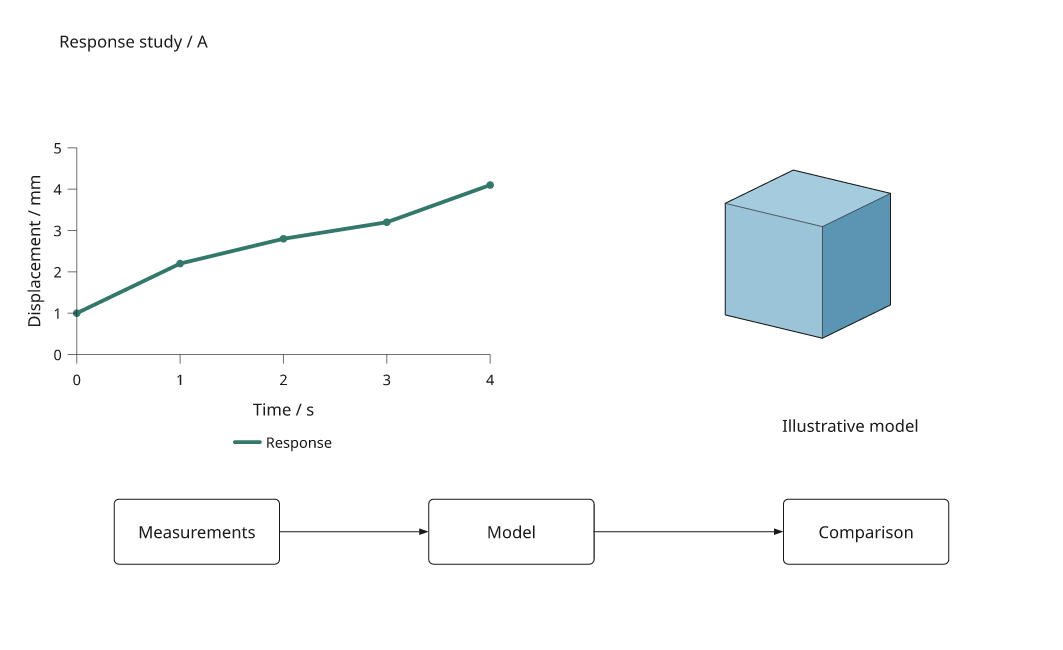
This example makes the chart narrower and shorter, moves the model and workflow, and adjusts one nested module. Saving and reopening the overrides reproduces the edited SVG at both 180 and 150 mm. The complete example uses live illustrative data and generated geometry.
Open the restored figure viewer.
The viewer supports zoom, pan and vector export. Edit layouts through the
Python APIs below or the local inspector (inklet.editor.LayoutEditor;
the old inklet.experimental.layout_editor path still works). This format is separate from the experimental linked-table
plot-style overrides.
Capture changes against a reference
Keep a reference recipe, copy it, then edit placements. The reference and edited recipe must have the same named composition structure when capturing changes. Supported named label differences are captured too. Supported named style differences are captured too; other content is not serialized into the layout file.
import json
from pathlib import Path
import inklet as i

base = i.composition(120, 70)
base.add('plot', i.plot_spec(x=(0, 2), y=(0, 4)).line([(0, 1), (1, 2), (2, 3)]).axes(),
         x=13, y=8, anchor='area-nw', width=base.page_width - 26, height=30)
base.add('caption', i.module('Response'), x=13, y=55)

edited = base.copy()
edited.place('plot', width=edited.page_width - 35, height=35)
edited.place('caption', x=18)
state = edited.layout_overrides(base)
Path('layout.json').write_text(json.dumps(state, indent=2, allow_nan=False))
layout_overrides(reference) captures changed x, y, anchor, width and
height and uniform scale fields on children, plus width, height, unit and fit_top on
compositions. It visits nested compositions through their named children.
Measured expressions remain expressions, so page resizing and dependent
content measurements still work after reopening.
A path such as /workflow/model names the model child of the root's
workflow composition; / names the root composition itself. Names provide
identity within the recipe hierarchy. Renaming or moving a target changes its
identity. Definitions hidden inside component factories or other BuildSpecs
are not traversed.
Named label decisions
Changed string module captions and text components are captured alongside layout. Plot titles, text and annotations require explicit string instruction keys; composition annotations require unique names. See the label editor for controls, identity rules and an executable example. Captures compare only matching label keys and kinds; they do not serialize added or removed content.
A saved label entry includes its kind and only the fields that changed:
{"schema":"inklet.composition-layout/0.4","targets":{"/caption":{"labels":{"label":{"kind":"module-label","text":"Reviewed response"}}}}}
Readers accept legacy schemas 0.1, 0.2, 0.3 and 0.4. New captures use 0.5; older readers
must be upgraded before opening them. Label fields are rejected under older
schema identifiers. Removed/incompatible labels appear as path#key in the
orphan report. Explicit missing='drop' retains compatible edits on that path.
Named appearance decisions
Schema 0.4 adds a styles group beside placement, page and labels.
Each named style contains its kind and changed fields. The appearance guide
lists supported controls, units, data-mapping exclusions and a combined edit.
A null style value removes an explicit keyword; unedited source fields stay
live. Capturing changes compares compatible named style keys and kinds, not
arbitrary renderer nodes or paint objects.
Source revisions that remove a style key, change its kind or replace a constant
with a data mapping produce a path#style:key orphan. With explicit discard,
compatible layout and label edits on the same path survive. The separate
linked-table visual-override format is not converted by this loader.
Restore on the current recipe
loaded = json.loads(Path('layout.json').read_text())
restored, report = base.with_layout_overrides(loaded)
assert report['orphaned_targets'] == []

def render(recipe, width=120):
    doc = i.document(width=width, height=75, margin=0)
    doc.add('report', recipe)
    return doc.compile()

assert render(restored).to_svg() == render(edited).to_svg()
assert render(restored, 140).to_svg() == render(edited, 140).to_svg()
render(restored).save('restored.svg', 'restored.pdf')
with_layout_overrides() returns an independent recipe and a reconciliation
report. It leaves the supplied recipe and JSON unchanged. As with composition
copies, explicit live data dependencies stay shared. New children and unedited
fields use the current Python definition. Saved decisions intentionally replace
current values for the fields they contain.
revised = base.copy()
revised['caption'].configure('Updated source label')
revised.place('plot', y=12)  # This field was not edited in the saved file.
updated, report = revised.with_layout_overrides(loaded)
assert updated['caption'].label == 'Updated source label'
updated_figure = render(updated)
updated_figure.save('updated.svg')
The file stores layout, supported labels and styles, not datasets, links, ports, constraints, factories or camera parameters. Keep the Python recipe and its assets alongside it. The containing document can supply its own render dimensions; restoring authored page dimensions does not override that parent layout contract.
Reconcile removed targets explicitly
Removed paths, page edits aimed at content that is no longer a composition,
and measured expressions referring to removed siblings are incompatible.
The default raises LayoutError and identifies the affected target paths.
Use missing='drop' only when discarding those entries is intended, and review
the returned report. An incompatible entry is dropped as a whole.
nested = i.composition(60, 20)
nested.add('label', i.module('Nested label'), x=5, y=4)
original = i.composition(100, 30)
original.add('group', nested)
variant = original.copy()
variant['group'].place('label', x=10)
saved = variant.layout_overrides(original)

new_source = original.copy()
new_source.replace('group', i.module('Replacement content'))
rebuilt, report = new_source.with_layout_overrides(saved, missing='drop')
assert report['orphaned_targets'] == ['/group/label']
Changing a child from one content type to another can retain its placement.
It must still support any requested placement anchor. Anchor availability,
geometry feasibility, division by zero and cyclic measured dependencies are
checked during compilation. Saved expressions support page dimensions,
measured child dimensions, child points and arithmetic, with a maximum nesting
of 32 operations. Malformed files, nonfinite numbers, invalid properties and
contradictory edits to a shared nested definition are rejected, including when
missing='drop' is used.
New files use inklet.composition-layout/0.5, adding named camera decisions.
The loader also accepts 0.1 files from dev7/dev8 (without scale), 0.2 files from
dev9 (without labels), 0.3 files from dev10 (without styles) and 0.4 files from
dev11/dev12 (without cameras). Unknown schemas
are rejected. Upgrade older readers before opening a 0.5 file. The JSON object
contains schema and targets; each target has changed placement, page,
labels, styles and/or cameras fields. This development-preview format is not a general
Python object serializer or an asset manifest.
Review revised content
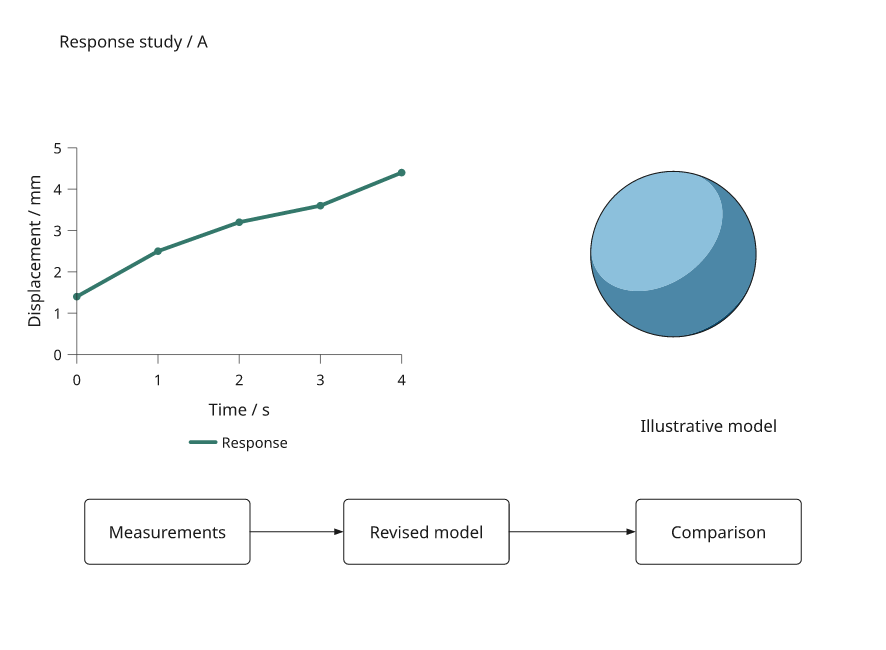
The same saved layout applies to new measurements, a replacement 3D object and
a revised module label. Run
python examples/composition_recipes.py --render --saved-layout to generate
the comparison files, layout-overrides.json and layout-reconciliation.json
in out/composition-recipes/. PNG generation requires the render extras.
In dev8, the local layout editor provides browser controls, undo/redo and Python-compiled previews using this saved format.
Saved camera choices
Schema 0.5 adds cameras alongside layout, labels and styles. The view key has
kind native-orbit or native-look-at, and only changed fields are recorded.
Camera editing documents the supported
native components and controls. Orbit/look-at changes and unsupported replacement
renderers report an orphan such as /model#camera:view. Explicitly dropping that
orphan preserves compatible placement, label and style choices on the object.
Schemas 0.1–0.4 remain readable but cannot contain camera edits.