

On this page
Importing microscopy TIFF files
inklet.volume.read_tiff reads local scalar microscopy channels into
immutable, calibrated Volume objects. Install the
volume extra, which includes tifffile.
The older inklet.experimental.tiff import path still works and returns the
same objects.
from inklet.volume import read_tiff

# Run with your local acquisition and its documented calibration.
image = read_tiff('acquisition.ome.tif',
    spacing_zyx=(.5, .1, .1), unit='um', origin_xyz=(0, 0, 0),
    source_id='experiment-17 / field-2', time_index=3,
    channel_names=['DNA', 'Actin'])
channels = image.channels
provenance = image.report()
For an executable real-data workflow, run the label intensity example. Its source helper verifies the downloaded file against a pinned SHA-256 before calling this importer. The core importer performs no downloads.
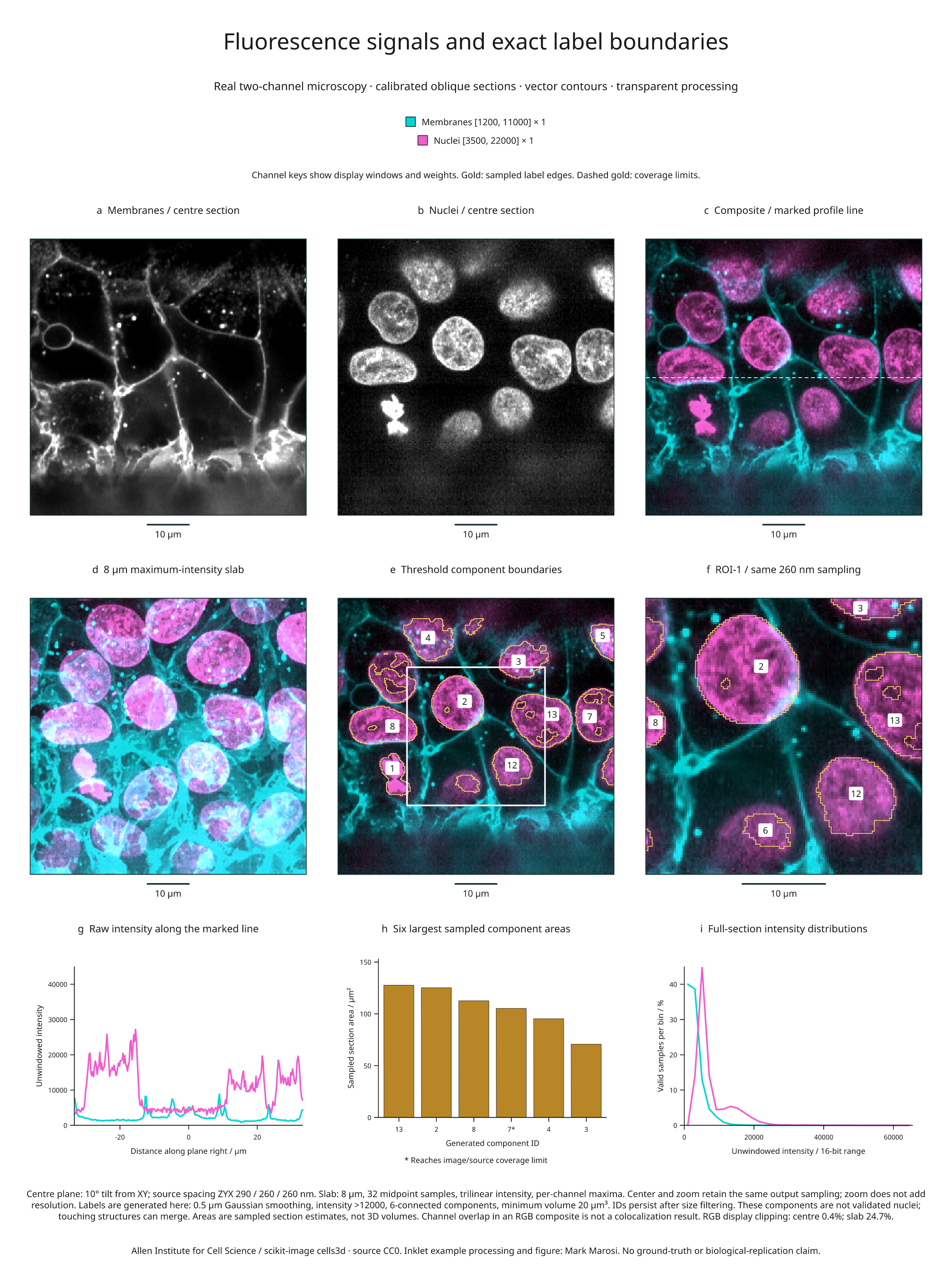
The fluorescence example uses imported TIFF channels. See that page for the source acquisition, calibration and reproducible recipe.
Explicit acquisition choices
read_tiff(path, *, spacing_zyx, unit, source_id, channel_names=None,
origin_xyz=(0, 0, 0), series=0, time_index=None, axes=None)
supports single-file
TIFF, ImageJ TIFF and single-file OME-TIFF series with scalar T,C,Z,Y,X axes.
The underlying tifffile reader supplies the
series axes and decoded array. Each channel becomes a ZYX volume.
- Calibration is required. Provide ZYX spacing and a supported physical unit
(
m,mm,um,nm). XYZ origin is the first voxel's centre. The default zero origin is a local coordinate convention, not an inferred microscope stage position. TIFF resolution tags and OME calibration are not automatically used. - Time is explicit. If the decoded series has a
Taxis, providetime_index, even if that axis has length one. A time index on a series withoutTis an error. A singleton time axis squeezed away by tifffile is absent from the decoded axes and is recorded that way. - Axes are checked. Unknown axes such as generic
QorIstacks are rejected. Supplyaxes='ZYX', for example, only when acquisition information establishes the correct interpretation. An override names each decoded array dimension once; it does not reshape or repair inconsistent metadata. - Channels have identities. Provide unique names in decoded channel order;
otherwise receive
channel-0,channel-1, etc. Names are caller declarations, not inferred stains or wavelengths. The volume source ID includes series, time point and channel index as well as the name.
Missing Z or C axes become singleton dimensions. A 2D image therefore still
requires explicit Z spacing to create a volume; avoid interpreting this chosen
thickness as an observed three-dimensional structure. series defaults to 0;
select another series explicitly for multi-series files.
Scope and provenance
The importer hashes the file and eagerly decodes the selected series, including all its time points, before selecting the requested time. Plan memory for both decoded data and immutable channel copies. It is not a lazy reader for very large acquisitions. Compressed TIFF codecs beyond the reader's built-in codecs can require a separately installed codec package; decoder errors propagate.
RGB photometric samples, unsupported axes, detected missing image pages, and OME references to other files are rejected. Multi-file OME acquisitions, pyramidal level selection, stage-position mapping and automatic metadata calibration are not supported. There is no missing-plane filling policy.
image.channels returns a fresh name-to-volume mapping. image.report() returns
a fresh JSON-compatible record containing the file's basename and SHA-256,
reader version, selected series/time, native and declared axes, override flag,
original shape, channel identities and supplied calibration. The hash identifies
the bytes read; it is not verification against a trusted source unless the caller
also checks an expected hash. No absolute local path is included in the report.