

On this page
Oblique microscopy sections
Introduced in Inklet 3.1, inklet.volume can sample an arbitrarily oriented physical plane
through calibrated microscopy and segmentation arrays. The same Plane defines
the output pixels, scale bar, projected annotations and rectangle in a 3D scene.
The inklet.experimental import paths used before 4.3 still work and return
the same objects. Install with pip install "inklet[volume,render]>=4.3".
From the release checkout:
python -m pip install -e '.[volume,render]'
Define one physical sampling grid
import numpy as np
import inklet as i
from inklet.volume import Volume, Plane

z, y, x = np.indices((9, 11, 13))
raw = Volume((20*x + 7*y + z).astype('uint16'),
             spacing_zyx=(0.4, 0.2, 0.3), unit='um',
             origin_xyz=(10, 20, 30), source_id='example:intensity')
labels = Volume(np.where(x >= 5, 7, 0).astype('uint16'),
                raw.spacing_zyx, raw.unit, raw.origin_xyz, 'example:labels')
plane = Plane(centre_xyz=raw.world((4, 5, 6)),
              right_xyz=(1, 0, 1), up_xyz=(0, 1, 0),
              shape_yx=(9, 15), spacing_yx=(0.15, 0.15), unit='um')
image_section = raw.reslice(plane, kind='intensity')
label_section = labels.reslice(plane, kind='labels')
assert np.array_equal(image_section.valid, label_section.valid)
assert set(np.unique(label_section.data)) <= {0, 7}
centre_xyz is the centre of the entire output grid in world coordinates.
Right and up are normalized physical XYZ directions; they must be nonzero and
orthogonal. Inklet rejects a sheared basis. Plane and volume units must match
explicitly. The source origin and anisotropic spacing determine which source
voxels contribute; directions are not specified in voxel-index coordinates.
shape_yx gives rows and columns. spacing_yx gives physical row and column
spacing. Output row 0 is at the top, with rows proceeding opposite the up
direction. Column 0 is at the left. Integer pixel indices identify centres;
outer edges extend another half pixel. A plane has zero thickness: this is a
point-sampled section, not a slab average or maximum-intensity projection.
Keep images, labels and annotations aligned
picture = image_section.diagram(width=90, window=(0, 350))
key = plane.scalebar(0.5, width=90)
centre_on_page = plane.project(plane.centre_xyz, width=90)
assert (centre_on_page.x, centre_on_page.y) == (0, 0)
doc = i.document(width=105, margin=5)
doc.add('section', i.vstack([picture, key], gap=3))
figure = doc.compile()
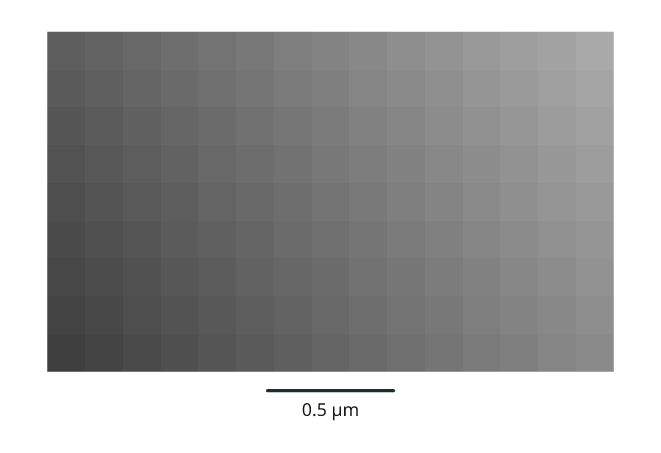
Rendered from the code above.
Page widths are in millimetres; scale-bar lengths are in the plane's physical
unit. Scale image and key together if resizing later. plane.world(row, column)
returns a physical XYZ position. plane.project() returns image-centred page
millimetres with +y downward and rejects points off the plane or outside its
rectangle. It does not establish whether a source volume covers that point.
plane.corners returns four physical pixel-edge corners. Connect them with
rendered.path3d() to show the same rectangle over a saved-camera 3D render.
That path can use depth-tested solid and dashed segments. It marks the sampling
plane; it does not cut away geometry or insert a textured surface into Blender.
Interpolation and source coverage
kind='intensity'uses trilinear interpolation and returns floating-point values, including when the source image contains integers. It does not round interpolated intensities back to the source integer type.kind='labels'requires an integer or boolean volume and selects the nearest source voxel. Half-index ties choose the upper index. Direct integer indexing preserves large IDs, includinguint64values beyond floating-point precision.- Samples inside the outer voxel edges hold the nearest edge-centre value when
necessary. Samples outside those physical edges are invalid. Their stored
value is zero, but the separate boolean
section.validmask distinguishes missing coverage from a measured zero or background label.
The intensity sampler uses SciPy's
map_coordinates
with order 1 and no spline prefilter. Label sampling is separate so interpolation
cannot invent IDs. Nearest-neighbour resampling is also an established image
sampling operation in ITK.
The section data and validity arrays are immutable snapshots. Its RGBA image has transparent invalid pixels. Place it over a visible backing to distinguish missing coverage in the figure. Reuse one intensity window across comparisons. Resampling does not increase acquisition resolution, and this API does not apply an anti-aliasing filter when choosing a coarser output grid.
Measure the sampled section
area = label_section.measure(7)
assert abs(area['area'] - area['sampled_pixels'] * 0.15 * 0.15) < 1e-12
assert area['area_unit'] == 'um^2'
Area is the number of valid output pixel centres assigned to the label, multiplied by output pixel area. An absent label has zero sampled area. Label 0 can measure background, but invalid samples are always excluded. Results depend on output spacing and plane position; they are not exact intersections of a surface, volumetric measurements or independent biological replicates.
section.report() records source calibration, plane geometry, interpolation,
boundary handling and valid coverage. Save it with the figure. The
real oblique-section example includes shared plane outlines,
matching microscopy and label panels, area comparisons and intensity profiles.