

On this page
Reusable figure projects
Keep a figure's measurements, layout decisions and object correspondence together as the analysis changes. This tutorial builds a small diagram from a file, moves one object, saves and reopens the project, connects its objects to plotted measurements, then replaces the measurements without losing the edit.
These objects live in inklet.project. The
old inklet.experimental.project path still works and returns the same objects.
Run the Python blocks below in order in a fresh working directory. The example
uses simulated data and the core installation. Saved files keep their
figure-project/0.1, assets/0.1 and entities/0.1 schemas; see the
API and saved-file policy.
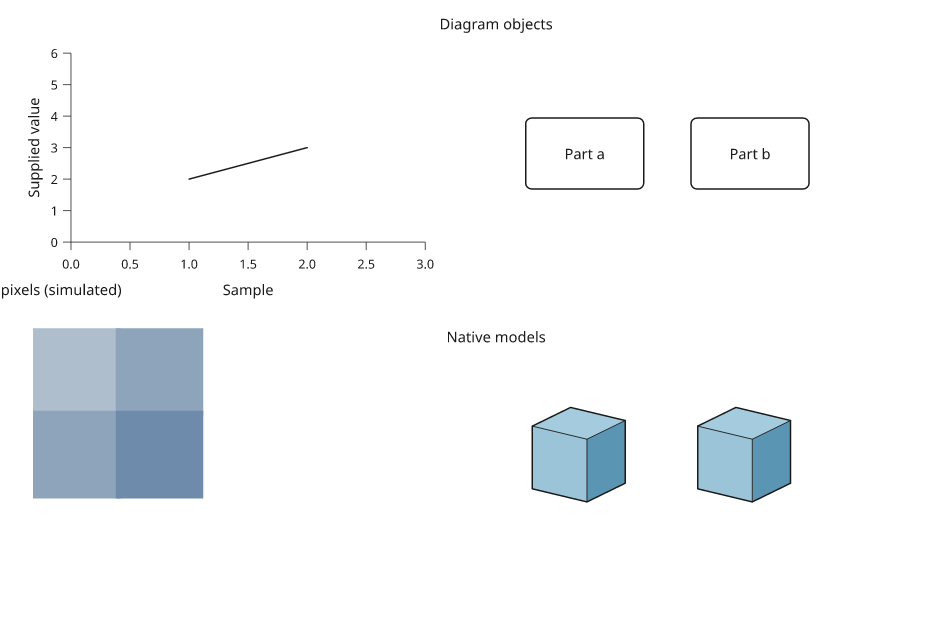
Complete runnable example · Acceptance workflow
Capture sources and author choices
Three small objects describe different responsibilities: AssetManifest
records the actual input files, EntityMap records which local objects refer
to the same entity, and FigureProject stores the composition and editor
choices through save and reopen. The Python recipe stays under your control.
Choose files explicitly and record their provenance. A manifest stores relative paths, byte counts, SHA-256 hashes, source, license, role and optional units. URLs are descriptive metadata; verification does not download anything.
import json
from pathlib import Path
import inklet as i
from inklet.project import AssetManifest, EntityMap, FigureProject

inputs = Path('project-inputs')
inputs.mkdir(exist_ok=True)
(inputs / 'measurements.json').write_text(json.dumps([2, 4]))
assets = AssetManifest.capture(inputs, [{
    'id': 'measurements', 'path': 'measurements.json',
    'source': 'Original simulated example', 'license': 'MIT',
    'role': 'measurements', 'unit': 'arbitrary',
}])
identities = EntityMap(['a', 'b'], {
    'measurements': {'sample-7': 'a', 'sample-9': 'b'},
    'composition': {'/left': 'a', '/right': 'b'},
})

def recipe(root):
    values = json.loads((root / 'measurements.json').read_text())
    result = i.composition(100, 50)
    result.add('left', i.module(f'A: {values[0]}'), x=10, y=15)
    result.add('right', i.module(f'B: {values[1]}'), x=60, y=15)
    return result

study = FigureProject('Supplied measurements', recipe(inputs),
                      assets=assets, identities=identities)
study.editor.command('edit', {'path': '/left', 'placement': {'x': 14}})
targets = study.select('measurements', ['sample-7'])
assert targets['composition'] == ('/left',)
bundle = study.save('saved-study', asset_root=inputs)
reopened = FigureProject.open(bundle, recipe)
assert reopened.selected == ('a',)
assert reopened.editor.figure.to_svg() == study.editor.figure.to_svg()
Open saved-study/.inklet/figure.svg or figure.pdf. You should see two labelled
modules, “A: 2” and “B: 4”; the first has moved from x=10 to x=14 mm. Reopening
reconstructs the figure from the copied input file and restores that placement.
The bundle contains the declared files plus .inklet/project.json, figure.svg
and figure.pdf inside .inklet/. Existing destinations are refused. Files are
verified before and after copying; failed staging is cleaned up. Extra files in
the source directory are not copied.
Reopening verifies input hashes before calling the supplied factory. It never
imports bundled Python automatically. The factory reconstructs the composition;
saved layout, labels, styles and native-camera choices are then applied. The
reconstructed SVG is then compared with its recorded digest. A different recipe,
font setup or Inklet version can change it: the project still opens, with an
ExportDriftWarning and open_report['export_drift'] set to True. Review the
figure, then save again to record the new export. Pass verify_export='strict'
to raise ValueError instead, for example in release checks, or
verify_export=False to skip the comparison. Asset verification always runs.
Hashes establish consistency, not trust in a recipe.
Connect different local IDs
The measurement key sample-7 and diagram path /left both identify entity
a. Selecting the measurement therefore returns /left as a related target.
The following table deliberately reverses the measurement order to show that
correspondence follows the declared IDs.
Entity IDs represent authored correspondence. Local IDs may be row keys, named composition paths, image-region IDs or mesh-face IDs. Display text and row order never establish identity. Maps are immutable and copied on construction.
selected(source, local_ids) returns canonical entities; targets(entities)
returns every mapped local target. Several local objects may refer to one entity.
Use validate_source(source, local_ids) to reject stale or incomplete inventories.
The reserved composition source validates paths against the actual recipe.
from inklet.selection import KeyedTable
from inklet.experimental.browser import BrowserFigure, ScatterView

measurements = KeyedTable('measurements', {
    'id': ['sample-9', 'sample-7'], 'value': [4, 2], 'position': [2, 1],
})
joined = identities.joined_table('study', {'measurements': measurements})
assert joined.row_ids == ('a', 'b')
assert joined.columns['measurements__value'] == (2, 4)
scene = BrowserFigure(joined, [ScatterView(
    'values', 'measurements__position', 'measurements__value', (0, 3), (0, 5),
)])
state = reopened.state_for(scene)
Path('linked-study.html').write_text(scene.to_html(state=state))
reopened.select_state(scene, state)
Open linked-study.html to inspect the scatter plot with entity a selected.
This standalone HTML file uses the selection supplied at export time. Changes
made inside that page do not update the Python reopened object automatically;
select_state() imports a validated state explicitly.
Joined columns are named source__column. Missing source entities yield nulls;
multiple source rows for one entity are rejected as an ambiguous join. Aggregate
those values explicitly before joining. Source reordering does not change the
canonical row order or reassign selections.
identities.view(source, table, view) adapts a DrawingView, LabelImageView,
MeshFieldView or GridFieldView to the same joined table. It preserves source
geometry, units and measurement validation while mapping picking/highlighting
IDs to entities. Source IDs and mappings remain in the exported layer's
correspondence metadata. This adapter currently requires an unambiguous entity
join; arbitrary many-face aggregation is not inferred. Field legends remain
measured furniture. The complete example
connects calibrated pixel picking, native drawing targets and plotted values.
Revise without silently discarding decisions
Call study.revise(new_recipe, assets=new_manifest, identities=new_map) to create
an independent revised project. Capture new input bytes explicitly. The default
rejects removed entities, reassigned local IDs and orphaned editor choices.
missing='drop' permits reconciliation and returns the removed entities, changed
bindings, removed selection and the existing layout reconciliation report. Old
project snapshots remain unchanged.
Here is a revision using a new input directory. Keep the same entity IDs because these are new measurements of the same two objects. The captured hash changes with the bytes, while the saved placement and selection are preserved.
revised_inputs = Path('revised-inputs')
revised_inputs.mkdir(exist_ok=True)
(revised_inputs / 'measurements.json').write_text(json.dumps([3, 5]))
revised_assets = AssetManifest.capture(revised_inputs, [{
    'id': 'measurements', 'path': 'measurements.json',
    'source': 'Original simulated example, revised measurements', 'license': 'MIT',
    'role': 'measurements', 'unit': 'arbitrary',
}])
old_svg = reopened.editor.figure.to_svg()
revised, report = reopened.revise(recipe(revised_inputs), assets=revised_assets)
assert revised.selected == ('a',)
assert revised.editor.overrides() == reopened.editor.overrides()
assert revised.editor.figure.to_svg() != old_svg
assert reopened.editor.figure.to_svg() == old_svg
assert report['removed_entities'] == []
revised_bundle = revised.save('revised-study', asset_root=revised_inputs)
assert FigureProject.open(revised_bundle, recipe).editor.figure.to_svg() == revised.editor.figure.to_svg()
Compare the two bundles' figure.svg files: the labels become “A: 3” and “B: 5”,
and the first module stays at x=14 mm. Reusing the old manifest for the new bytes
would fail verification, so the revision captures its own declared inputs.
Project selection is canonical entity selection. The bundle does not save browser viewport/filter state or editor undo history; save a linked view's own state when those choices matter. Selection does not silently restyle a native composition: use returned targets for authored highlights, or the mapped linked views for interactive highlighting. Exact image picking and mesh XY picking retain their existing geometry limits; this does not add depth-aware 3D selection.
For a complete saved/revised example, run:
python examples/project_workflow.py --output out/project-workflow
python -m pytest -m acceptance
Use a new output directory for another run. The native project export keeps text and geometry editable; linked image views embed their actual source pixels.