

On this page
Deterministic chaos
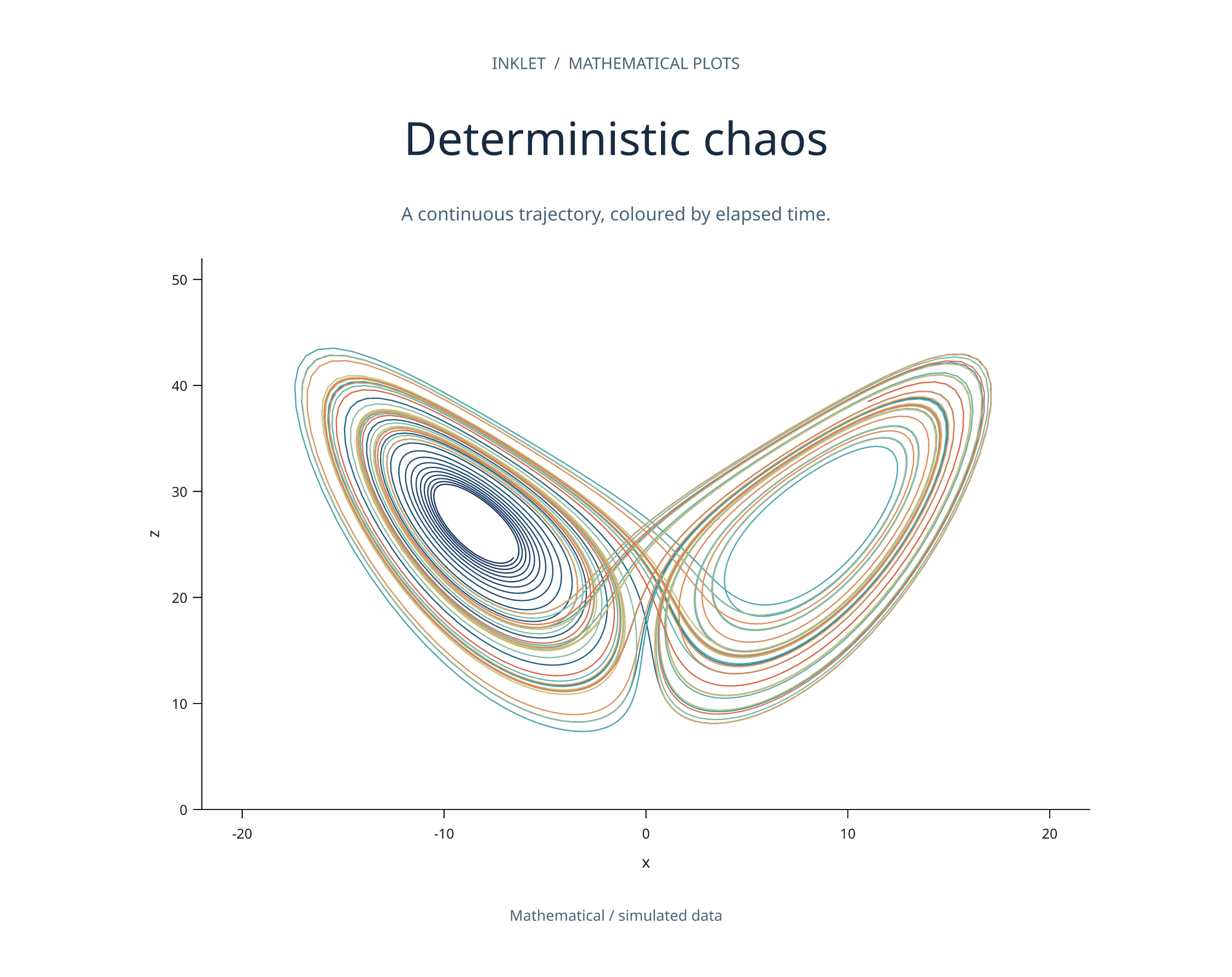
A Lorenz trajectory, drawn as continuous vector strokes. Inklet 3.0.
What this figure shows
The trajectory is integrated with fourth-order Runge–Kutta, using a fixed initial state and time step. Consecutive segments share endpoints. Colour indicates elapsed integration time.
Run the example
Install the rendering extras from the release checkout. This example does not require Blender or downloaded assets. See installation for the release checkout and showcase setup for independent PDF previews.
python -m pip install -e '.[render,images]'
python tools/showcase_gallery.py --only attractor --quality final
Open out/showcase/attractor/figure.html to review the result. The same folder contains figure.svg, figure.pdf and figure.png.
Adapt it
Change the data definition, ranges or colours in the attractor() builder. This is the function used by the gallery recipe:
import math
import inklet as i


def attractor():
    def f(p):
        x,y,z=p
        return (10*(y-x), x*(28-z)-y, x*y-8*z/3)
    p=(1.,1.,1.);points=[]
    for step in range(6500):
        dt=.01;k1=f(p);k2=f(tuple(a+dt*b/2 for a,b in zip(p,k1)))
        k3=f(tuple(a+dt*b/2 for a,b in zip(p,k2)));k4=f(tuple(a+dt*b for a,b in zip(p,k3)))
        p=tuple(a+dt*(b+2*c+2*d+e)/6 for a,b,c,d,e in zip(p,k1,k2,k3,k4))
        if step>=500:points.append(p)
    panel=i.panel(137,85,x=(-22,22),y=(0,52))
    ramp=i.ramp(['#19355f','#25899b','#64b9b1','#d9bb71','#d85e45'])
    # Small consecutive segments retain an entirely vector trajectory.
    for start in range(0,len(points)-1,30):
        segment=points[start:start+31]
        panel.line([(x,z) for x,y,z in segment],stroke=ramp(start/(len(points)-1)),stroke_width=.20)
    panel.axes(x='x',y='z')
    return panel.build()