

On this page
Historical material
This page preserves an earlier release or study. See the current guide for supported behavior.
Research preview: regions and crossings
The second preview adds sampled-region requirements, optional leader-crossing
reduction, and physical label-displacement measurements. Introduced in 3.1.0.dev2, it ships in Inklet 3.1 under
inklet.experimental.figure_planner. Signatures and report schemas remain experimental.
The first preview explains camera selection and author locks.
Run the study · Full recorded results
Require more than a visible anchor
A single visible point does not establish that a component can be identified.
Region lets an author supply surface samples and require both a visible fraction
and a minimum projected extent:
from inklet.experimental.figure_planner import Region, Target, plan

surface = Region(
    samples=((-0.5, 0, 1), (0, 0, 1), (0.5, 0, 1)),
    min_visible_fraction=0.7,
    min_span_mm=8,
)
target = Target("display", "Display", (0, 0, 1), region=surface)
result = plan([target], views, width=180, crossing_penalty=25)
This snippet requires your rendered views and surface points in the same scene
coordinate system. Choose samples on the geometry you mean to identify. The
planner does not infer the association between a sample set and an object.
Every supplied sample enters the denominator, including samples outside the
frame or with unknown depth. The visible fraction counts only in-frame samples
that pass the depth test. Missing depth cannot satisfy a region requirement,
even if the target itself uses visibility="in_frame".
The visible extent is the longest side of the visible samples' projected bounding
box, measured after scaling to the candidate image width. This can rule out
an image-size choice that would otherwise shorten leaders. The target's own
anchor must also satisfy its visibility policy. Regions require 2–4096 distinct
finite samples, a fraction in (0, 1], and a positive extent.
These are sample-based requirements. They do not measure visible pixel area, continuous surface coverage, readability of text inside a raster image, or human object recognition. Sparse or poorly chosen samples can miss occlusion. The report retains sample counts, unknown/out-of-frame evidence, visible fractions and the selected projected extent so authors can inspect the decision.
Reduce crossings without moving locked labels
crossing_penalty=25 adds 25 mm-equivalent cost per crossing leader pair. The
planner first solves its usual linear assignment, then searches for improving
moves to free slots and swaps between two labels. Every move preserves visibility,
region-size constraints, unique slots and author locks.
The crossing measure counts proper intersections of the actual two-segment leaders, once per pair and only within a panel. Shared endpoints and collinear overlaps are excluded. It does not measure stroke clearance or intersections with scene features.
This pair cost changes the optimization problem. With crossing_penalty=0
(the default), the finite linear problem is solved exactly as in the first
preview. With a positive penalty, refinement is a bounded local search;
it does not guarantee a global optimum or zero crossings. The total score may
trade longer leaders or changed prior slots for fewer crossings. Hard locks
remain mandatory even when they force a crossing.
max_refinement_steps defaults to 12 and may be zero. Each accepted step strictly
reduces the combined cost. Reports include the initial/final crossing counts,
step count, assignment method, and either local_optimum or step_limit.
A step-limit result is feasible but does not claim convergence. Enumeration of
camera subsets and image sizes still obeys max_evaluations.
Measure actual revision movement
Plan.label_positions() returns each label's inner-edge centre in millimetres
from the plan's top-left corner. The report includes those positions and
constraints.revision_displacement_mm for IDs shared with the previous plan.
This catches movement that a slot-change count misses: keeping the same view, side and row can still move a label when the page or image changes size. The coordinates describe the plan itself, before a document places or transforms it. Physical movement is reported as evidence; the current preservation cost still penalizes slot changes rather than distance moved.
The recorded dev2 report schema is inklet.figure-plan/0.2.
The third preview adds movement controls and schema 0.3. The added region evidence,
refinement status, crossing pairs and page positions are experimental.
Reproduce the study
From the release checkout installed with pip install -e '.[render]':
python examples/research_planner_study.py --quality final
Use --blender /path/to/blender to select an installation. The script creates
original laboratory, product and architectural templates plus the complex lab,
and renders their authored cameras with depth. Cycles defaults to an available
GPU, with CPU fallback during discovery.
It compares three methods at 120, 180 and 240 mm page width for 36 cases:
| Method | Point visibility | Sampled region / minimum extent | Crossing penalty |
|---|---|---|---|
| Point | Required | None | 0 |
| Region | Required | At least 70% / 8 mm | 0 |
| Region + crossings | Required | At least 70% / 8 mm | 25 |
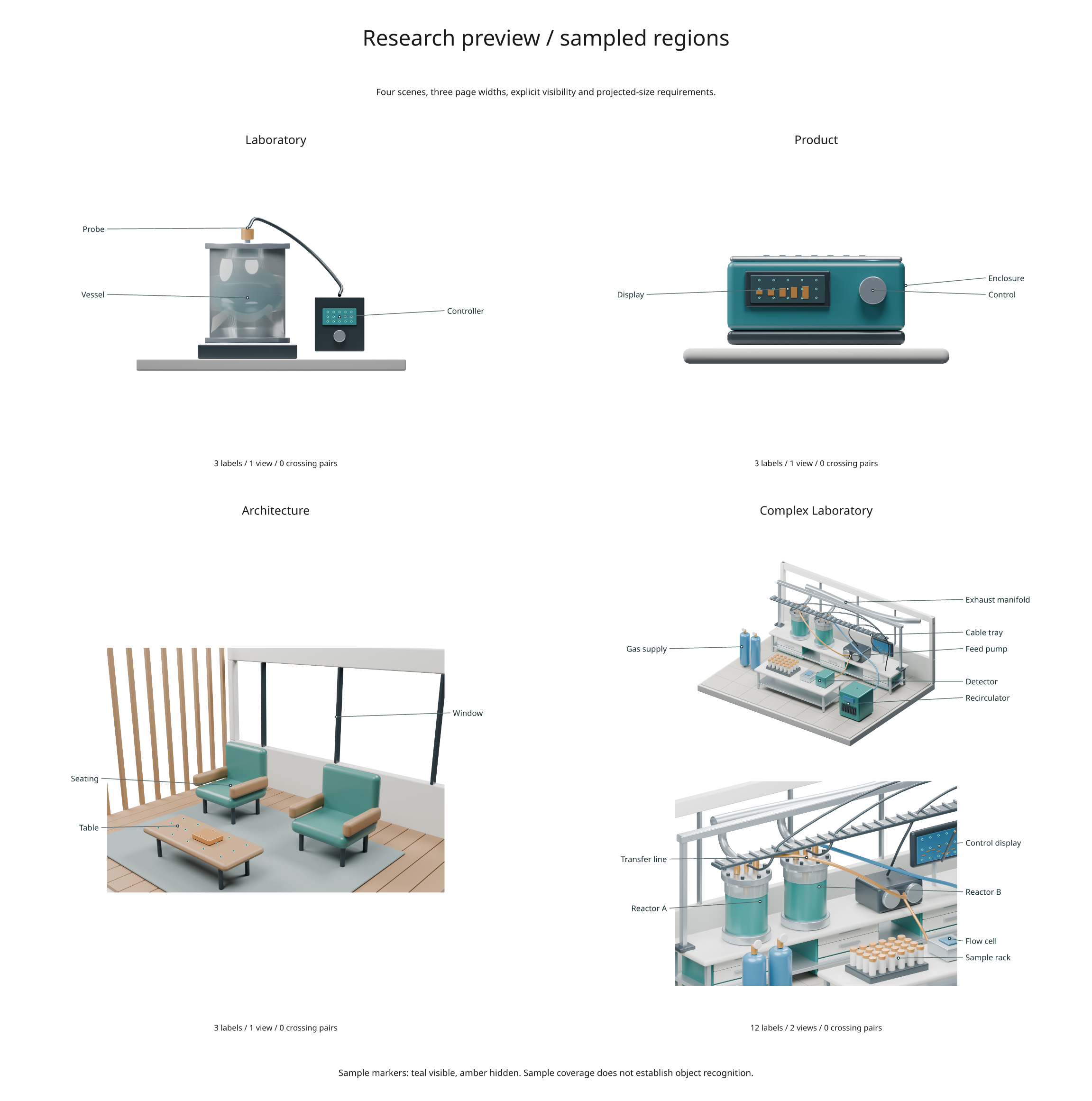
All methods share the same scene snapshots, font size, page-height bound, camera bank, and maximum of two selected views. Region samples are prescribed on a controller readout, product display, tabletop or laboratory control display. Each scene's coordinate-to-metre conversion and depth tolerance are recorded. The architecture case explicitly chooses exposed table and mullion anchors; the template's default table anchor is under its book.
Planning time excludes Blender rendering and export. The output contains full JSON reports, individual feasible figures and a four-scene comparison. A feasible 180 mm region+crossings plan is preferred for the gallery; otherwise the script uses another feasible width and retains every failure in the data.
Recorded results
The checked final-quality run contains 32 feasible plans and four explicit failures. The two region methods reject both laboratory scenes at 120 mm because the sampled readouts cannot reach the required 8 mm projected extent. Their point-only plans pass. Product and architecture pass at all three widths.
At 180 and 240 mm, the complex lab's point-only plan selects Overview + Services; adding the region requirement selects Overview + Process. Services exposes only 9 of 15 control-display samples (60%), while Process exposes 14 of 15 (93.3%). At 180 mm the selected visible extent is 11.69 mm.
All feasible ordinary study cases already have zero proper leader crossings. The optional crossing penalty therefore makes no changes to those layouts. Its effect is demonstrated separately in the controlled revision below. These results are specific to the authored cameras, sample sets and render settings; they do not establish general superiority over point-only planning.
What this experiment can establish
The tests check that sampled visibility and projected extent actually constrain camera/size choices, and that local moves/swaps reduce the stated objective while preserving hard constraints. They also cover forced crossings, free-slot moves, zero-step limits, unknown depth and physical movement with unchanged slots. The linear assignment continues to be checked against exhaustive small problems.
The scene study measures the effect of adding constraints to this planner. It is not a comparison with expert authors or other visualization systems, and a lower crossing count alone does not establish better figure quality. The next experiments should vary sample density and camera candidates, measure object regions from rendered IDs, and compare author correction effort.
Controlled crossing revision
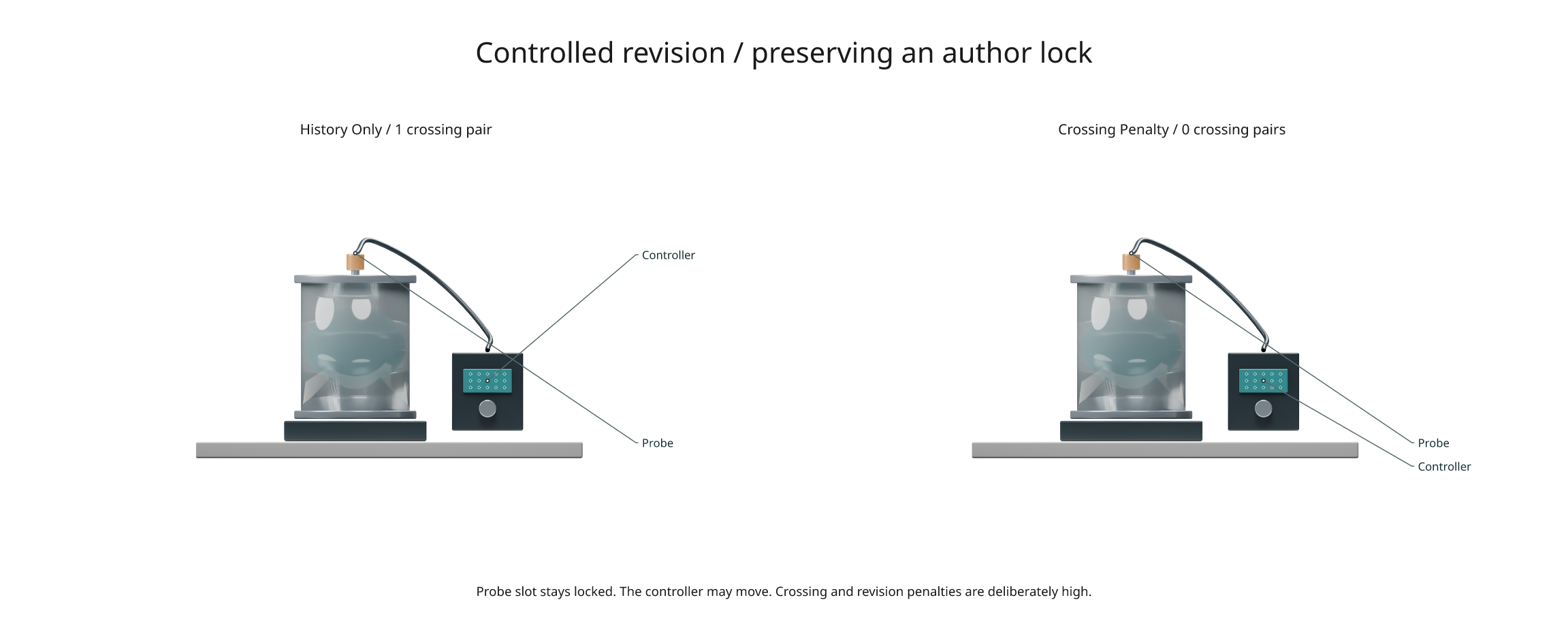
The additional controlled case starts with two deliberately crossed author preferences on the laboratory's Front view. It retains the probe's hard slot lock and permits the controller label to move. History alone retains one crossing; a high crossing penalty removes it by moving the controller.
The penalties (1000 per changed slot and 5000 per crossing pair) are deliberately
large to isolate the behavior. The camera, page, geometry and region requirement
are identical in both runs. This is an adversarial solver check, not evidence
that typical figures need those weights. The prior plan and both revised plans
are included under controlled_revision in the recorded JSON.
Use result.diagram(show_regions=True) to draw sample markers for inspection.
Teal means visible, amber hidden and grey unknown. Out-of-frame samples remain
in the evidence but are not drawn beyond the image boundary.