

On this page
pandas and Polars inputs
Create an immutable KeyedTable directly from a pandas or Polars DataFrame,
then use it in linked plots, facets or joined maps. Import it from
inklet.selection (4.3); the old inklet.experimental.selection path still
works and returns the same class. The adapters need the optional pandas or
polars extra.
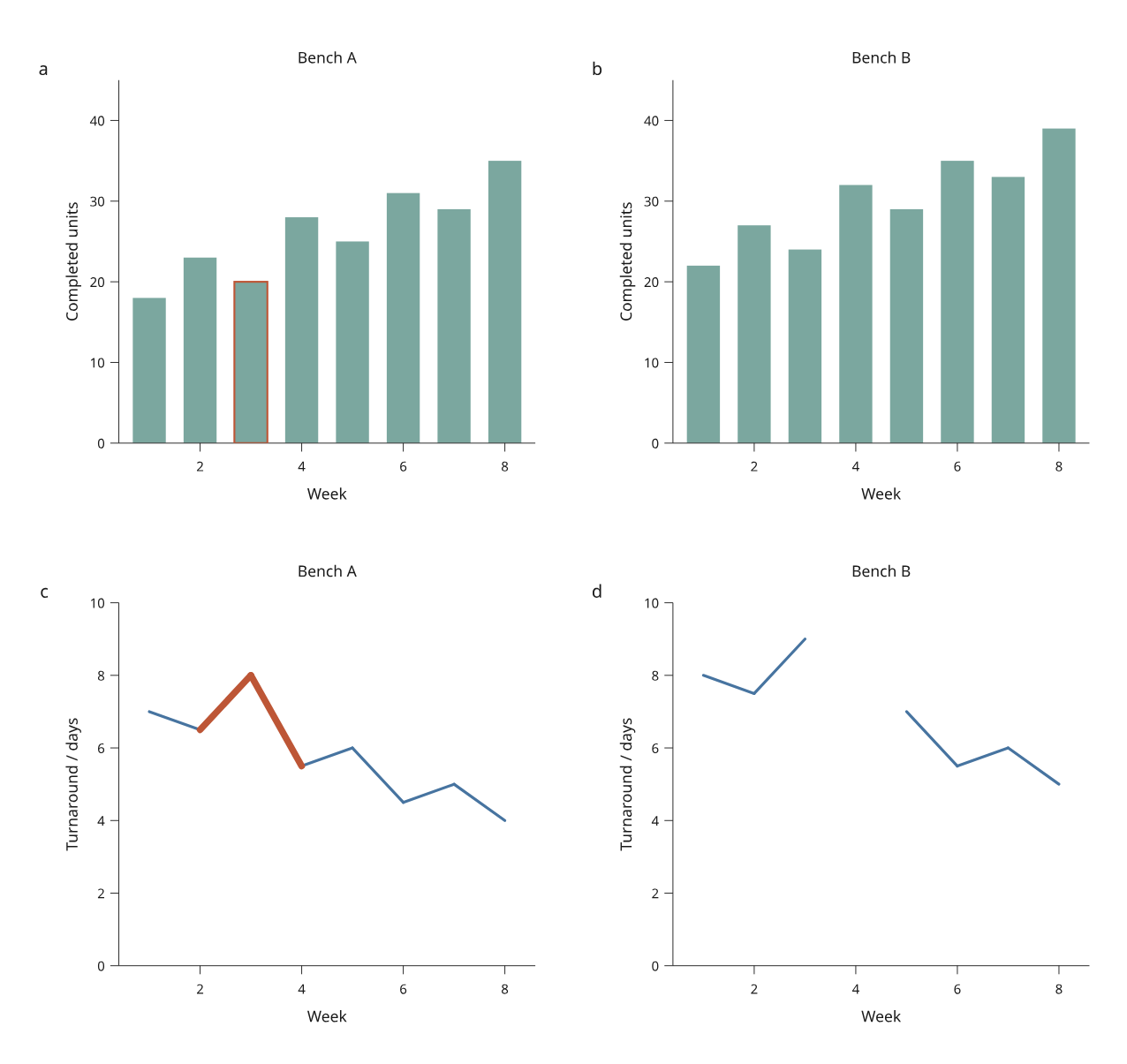
Open the interactive figure · Complete Python recipe
The example imports 16 simulated workshop observations. Both adapters produce
the same data digest, measured scene and SVG. Bench B has missing turnaround
in week 4, so its line has a gap. The orange marks identify the selected
a-3 observation across its two panels. All values are invented MIT material
by Mark Marosi; they are not measured production data.
Install the integration you use
From a development checkout:
python -m pip install -e '.[pandas]'
# Or:
python -m pip install -e '.[polars]'
pandas 2.2–3.x and Polars 1.x are the supported version families. Each is an optional integration imported only when its adapter is called. Core plotting and exported HTML require neither library.
Build a keyed snapshot
import pandas as pd
from inklet.selection import KeyedTable

frame = pd.DataFrame({
    "sample_id": ["a-1", "a-2", "a-3"],
    "week": [1, 2, 3],
    "units": pd.array([18, None, 20], dtype="Int64"),
})
table = KeyedTable.from_pandas("workshop", frame, key="sample_id")
The equivalent Polars input:
import polars as pl
from inklet.selection import KeyedTable

frame = pl.DataFrame({
    "sample_id": ["a-1", "a-2", "a-3"],
    "week": [1, 2, 3],
    "units": [18, None, 20],
})
table = KeyedTable.from_polars("workshop", frame, key="sample_id")
name identifies the logical table across revisions. key names a column
containing unique, nonempty strings. It defaults to "id". The pandas index is
ignored, including named and multi-level indexes. If an index contains the
intended IDs, explicitly turn it into a string column first. Numeric keys are
rejected rather than converted automatically.
Source row order is retained. Inklet copies the scalar values; later frame edits cannot alter an existing table, figure or saved state. No sorting, aggregation, interpolation or row removal takes place during import.
Missing values and supported columns
| Input | Result |
|---|---|
| Strings, booleans, portable integers, finite floats | Built-in Python scalar values |
None, pandas NA/NaT, floating-point NaN, Polars null |
None; rows remain present |
| String categorical or enum values | Strings; category metadata and unused levels are not retained |
| Positive or negative infinity | Error naming the column and zero-based row |
Integers outside [-(2**53-1), 2**53-1] |
Error; represent identifiers or exact large values as strings explicitly |
| Dates and timestamps | Require explicit time_columns; see linked time series |
| Durations, decimals, complex numbers, nested cells | Error; convert explicitly or omit the column |
These rules account for pandas missing-value representations
and Polars' distinction between null and NaN.
The direct KeyedTable(name, columns) constructor still requires native JSON
scalars and explicit None; its stricter contract is unchanged.
By default all columns are imported. Select an ordered subset to omit fields that the figure does not need:
table = KeyedTable.from_pandas(
    "workshop", frame, key="sample_id",
    columns=("sample_id", "week", "units"),
)
The subset must include the key. Unknown names, repeated names and unordered sets are rejected. Source headers must be unique nonempty strings even when selecting a subset. Unselected cells are not converted or validated.
Polars lazy inputs must be collected explicitly by the author before import.
There is no implicit query execution. Neither adapter stores dtype metadata,
units or provenance: record units in your axes and supply the figure's source
credit. For facets, specify category order with
FacetView(..., values=...).
Matching normalized scalar values give matching digests across libraries.
An integer 1 and a float 1.0 remain distinct; if pandas infers a float column
from integers mixed with missing values, choose a nullable integer dtype when
that is the intended representation.
Revise, explore and export
python examples/v4/table_inputs.py --backend pandas --output out/v4-tables
python examples/v4/table_inputs.py --backend polars --output out/v4-polars

# Reconstruct a saved view from the original data with either adapter.
python examples/v4/table_inputs.py --backend polars \
  --state /path/to/view.json --output out/v4-restored

# A view saved after applying the correction needs that same revision.
python examples/v4/table_inputs.py --backend polars --revised \
  --state /path/to/corrected-view.json --output out/v4-corrected
The recipe writes offline HTML, vector SVG and saved JSON state. In the browser,
expand Data revision and apply Corrected. The selected a-3 bar changes
from 20 to 24 units; its turnaround remains 8 days. The revision also removes
b-8. If that row is selected or explicitly filtered, the default policy rejects
the switch until you choose Drop removed IDs. Inspect the change report.
To update your own figure, create a new table with the same name and key and
call figure.replace_data(new_table, state=saved_state). See
data replacement for removed-ID and viewport policies.
Saved state can move between adapters when their normalized inputs and measured
scene match exactly. Revisions with changed contents require explicit rebasing.
Linked time series now add explicit calendar/UTC axes and opt-in temporal columns. Grouped summaries and statistical views remain upcoming.